
The conference just moved to a separate room together. The speaker is introducing the different panelists of the conference. Each have a unique background, such as growing up in Ghana and exploring art scenes from Mexico. The organization “Artist Coalition for Equitable Development” is all about fostering the soul in the community of the city. They are talking about what it means to make space more inclusive in Seattle. The general trend is that Seattle is shifting from a “neighborhoody” city to a more money-driven city. They said it’s important to confront the lawmakers directly in order to make a change, even if its is uncomfortable. Ana Cano aka “Black Mama” is giving her experience of the same phenomenon happening in Ecuador. She is driving home the point that everybody must come together to fight to make a change.
Womxn Who Rock Blog Post #2 : Group X
Claiming Space Breakout Session

The first breakout session was quite informative. The first breakout session, Claiming Space as Womxn Of Color. Inspired me about the topic of “equitable, sustainable development” in the Seattle area that can help young artists on the uprise. Currently, “the city is getting more crowded and expensive to live in”. This seems to be pushing out marginalized peoples in the Greater Seattle Area. We’re gonna have to come together and fight together to prevent “millionaires and billionaires from kicking us out”.
One speaker talked about how we must stand up, come together, and stand together to creative lasting change in Seattle and the World.
One impactful idea I got from one of the speakers is to own who you are. I think that this idea is very valid and applies to school, professional work, and life. It’s also very true in the music industry as many African-American female musicians kept on singing and being themselves, which ultimately lead to their success. After many years of oppression and negativity, these artists’s work finally started to get played on the radio.
Group 13 Women Who Rock Live Blog #1
The Women Who Rock Conference has begun! Cecile Ann Hansen is the chair of the Duwamish tribe. She fought many injustices towards the Duwamish tribe, such as the loss of traditional lands and the loss of fishing rights. The Women Who Rock conference started out with a blessing from her, which is inspirational coming from somebody with so much history and relations to the Native Americans of Washington. This relates to the idea of giving everybody a voice. The Native Americans have a history of being suppressed by others and the government, so it’s important to hear what Cecile Hansen has to say and share in her experiences. Although she is not a woman rocker, she relates to the theme of claiming space in the changing city of Seattle. Despite Seattle evolving, she strives to get her voice out there and have others share in the important tradition of the Duwamish tribe.
Womxn Who Rock Blog Post #1: Group X
Off to a great start. The Women Who Rock Conference held at MOHAI started with a bang.
It was a beautiful day in Seattle. Sunny, but not too cold.

MOHAI served as a great stage for the Womxn Who Rock (UN)Conference. Attendees seemed pleasantly surprised by the amazing space.
When I walked in, I was immediately taken back by amazing setup. I was drawn to the Altar, where many stories of female strength in music were shared.

At around 10:45 am, attendees were enthralled by an Opening Blessing by Dwamish Tribe Chairwomen Cecile Hansen. She was very thankful to be included in the Agenda for the day. I found it funny when it said that “the Dwamish are still here”, reminding conference attendees that Native American heritage is still alive and well in the Pacific Northwest. The ceremonial blessing was a nice way to start out the conference because it helped to get people into the mood. It also made people thankful and appreciative of all the work that women did in this world that helped pave the way for future advancements in music.

Unapologetically Chingonx – Group 5 Dia De Los Muertos Midterm
Social Critique Category:

Pictured: Group altar honoring the murdered women in Ciudad Juarez, Mexico. Bottom quote says, “”Este Cuerpo es Mio, No se Toca, No se Viola, No se Mata!” Top quote says, “No Mas Femicidio/No More Femicide”. Photograph taken by Clarissa Suarez at Dia De Los Muertos event at Centro De La Raza, 11/02/2017.
We incorporated the theme of monarch butterflies representing unity and transition or movement without borders. Likewise we critique male-domination in the church through the pink and black cross with the female sex symbol and a raised fist in the middle, this was inspired from the women’s march that occurred after these murders in Mexico.

Pictured: Skeletons dressed in traditional Mexican clothing sitting at dinner table surrounded by cultural paintings and an altar. Photograph taken by Clarissa Suarez at the Dia De Los Muertos event at El Centro De La Raza, 11/02/2017
This particular art exhibition had no background information, but I personally believe it fit the category of domestic space because it shows a man and woman skeleton at the dinner table, so they are spending quality time together.
In addition, this picture fits the category of domestic space and identity because in the background there is an altar with a photo of the Virgen de Guadalupe; in a way this shows the traditional family settings in Mexican culture around the time of Dia de Los Muertos celebration.
Healing Category:

Pictured: Altar dedicated to the victims of the shooting in Pulse nightclub in Orlando, Florida. Poem reads, “The Latin gay, lesbian, bisexual and transgender community wishes to honor our dearly departed ones. HIV/AIDS is not the only cause of death, we are also victims of violence, homophobia, discrimination, fear, and we must not forget, natural causes. In order to prevent those types of deaths, let us fight against violence, discrimination, homophobia, and the fear of all that is different within our society”. Photograph taken by Anthony Runestrand during set-up at El Centro De La Raza, 10/31/2017
I saw the man putting the altar together, I recognized him from the hill but I unfortunately was not able to talk to him. On the Thursday (Dia De Los Muertos) I did not see him at the altar or throughout the exhibit; I would have enjoyed talking to him and thanking him for the ofrenda. As seen in the picture each votive candle is wrapped with the face of each individual life lost in the shooting; these loved ones may be gone but their spirits are still alive and I hope they continue to dance. This altar helps to heal and remind us that we are all precious people deserving of life on this earth.
Identity & Social Critique Category:

Pictured: Poet Claudia Castro Luna and her altar dedicated to the murdered women of Ciudad Juarez, Mexico. Photograph taken by Gema Soto-Marquez at Dia De Los Muertos event at El Centro De La Raza, 11/2/2017.
The imagery she used was purposefully feminine presenting in order to convey the fact that is this a gendered issue, it is a result of patriarchy and therefore an identity claim to femininity as Latinas within this holiday is a form of resisting and critiquing the politics surrounding violence against mujeres in our communities.
Interviews:
Claudia Castro Luna: After seeing her altar, I continued to talk to her to find out she is from El Salvador and has practiced Dia De Los Muertos ever since she came to the U.S. to keep in touch with her roots. “It reminds me of mi abuela,” she says. She also has been very eager to participate at this event and this was her first time presenting an altar at El Centro De La Raza. She hopes to continue to use art as part of her activism and to engage in conversations that revolve around issues she cares about such as femicide.
Steven from People of Color Against Aids Network: Steven was the representative for POCAAN at the event and had created their altar to be presented in the exhibition. When asked what POCAAN wanted to convey in their altar, Steven talked about how it’s based off the struggles people of color face by being disproportionately affected by HIV. Many queer people of color have died from it, including activist Victor Rivera, who’s picture was on display on their altar as a memorial to him.
Every picture we chose to highlight we had an emotional attachment to. The domestic space element seen in the 2nd picture has a comforting familiarity. The altar of the Pulse victims was critical because in this ceremony of remembrance, we can heal and continue to fight for rights of LGBTQ+ people of color. The interview with POCAAN also highlights health issues QTPOC face. The picture of the altar for the women of Juarez deserves a shout-out for socially critiquing the current state of violence towards Latinas. Claudia Castro Luna’s interview gave us a deeper, personal perspective of the feminista behind that altar. Through acknowledging the existence of these marginalized communities, we can resist.
Links to Live Blog Posts:
Part 1: https://womenwhorockcommunity.org/2017/11/03/unapologetically-chigonx-queering-altar-making/
Dia de los Muertos: Live Blog #2
It’s pouring outside now. The air feels fresh but not cold. It’s filled with the smoke coming from the Aztec danza ritual. And the drums are following the rhythm of my beating Corazon. I feel so connected with the world around me. The drums, the dancers, the rain, the luna llena and the love that is surrounding me by my beautiful soul sisters. All of the sudden there is a loud rumble of thunder that falls from the sky. We felt the sound vibrations run through our bodies and the dancers yelled to the skies. And that’s when we knew that we were all meant to be there in those moments. The night ended beautifully.
Dia de los Muertos: Live Blog
I’ve had a wonderful time so far with the food, the people and the vibes. I did however encounter moments where I found white people taking up space in a POC space. Firstly, the two white women who dressed up as clowns and put on a show, made me a little uncomfortable because I felt it was a very sacred and spiritual space and I didn’t feel like they fit in. Not only were they taking up physical space but also time.
Secondly, there was a group of high school students who came to the event for their Spanish class. Most of them were white. I was standing next to them and they were being so loud and obnoxious with their rude comments. They were attempting to speak Spanish but they were speaking it very sarcastically. They were also taking up physical space. There were so many of them at the front and in seats when they could have offered the elderly women their seat or even allowed members of the community closer to the front.
Lastly, I was walking away and one of the girls said “adios” with attitude and a strong english accent and very sarcastically. Before I left I let them know that the next time they enter POC spaces, to not take up too much space and to be respectful, know their place as white people.
Dia De Los Muertos celebration
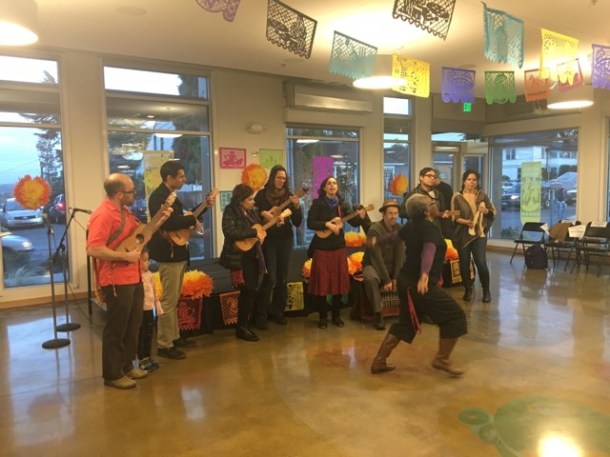
Pictured above: The Seattle Fandango Project performing at El Centro de La Raza’s Dia de los Muertos celebration on 11/02/2017. Photo taken by Maria Tracy
Category: Focus on Cultural Identity
The Seattle Fandango Project is performing and sharing their cultural traditions with all the attendees. They were playing their instruments, singing, and dancing. They were celebrating their culture and identities. Those who assisted the event could reminisce or feel joy to partake in something that reminds them of home and family.

Pictured above: Our group’s altar honoring those who passed away crossing the U.S.-Mexico border at El Centro de la Raza’s Dia de los Muertos celebration on 11/02/2017. Photo taken by Karen Gamez.
Category: Ceremonial/healing
Our altar is honoring those who have passed away by celebrating their lives. In a way, we are also doing community healing to help with our pain of losing them. Through our altar, we hope to remember those who lost their their lives attempting to cross the border in search of a better life. Frequently, their families are unaware of their whereabouts. We are also speaking out against the immigration system that does not care about these people.
Interviews:
- “The celebration of life and remembering that death is the end of a journey and continuation of another one. Beyond the skulls, there is a history of our ancestors that is passed on. It needs to be recognized and celebrated and passed on” – Nayeli Mercado, 3rd year her family does the altar for Roberto Maestas, the main altar
- “It’s a time to remember our dead, to commemorate their life, and to remember that some days are harder than others. It’s a time for you to make your peace. You have a day set aside for mourning every year. It’s a healing process and a healing opportunity” – Connie Muniz: instructor/leader of Folklorico Tonantzin, her group was performing (Mexican folk dance), was wearing a traje tipico de Mexico.
Our group selected the photograph because it showcases convivencia and community building through music and dance. We selected the photo because we wanted to capture our group’s involvement in honoring those who have passed and our participation in promoting our unique cause. We chose to include the interview with Nayeli Mercado because she highlighted that Dia de los Muertos is a cultural event that celebrates death as a state transition instead of mourning it as the end of our journey. We included the interview with Connie Muniz because she focused on the healing aspect of the celebration and altar-building process.
By: Group 2- Stephanie Badillo-Sanchez, Maria Tracy, Karen Gamez
Group 3: Post-DDLM

Bridge Creation/Altar at DDLM , Photo Credit: Angela Kwak

Group 3’s Altar, Photo Credit Photo: Janet Thomas
Group 3’s Altar, Photo Credit: Janet Thomas
Bridge Creation/Altar at DDLM Event, Photo Credit: Angela Kwak
Date: November 2nd, 2017
Location: El Centro de la Raza
Event: Dia de los Muertos, Honoring Those Who Built Bridges Not WallsDate: November 2nd, 2017
Location: El Centro de la Raza
Event: Dia de los Muertos, Honoring Those Who Built Bridges Not Walls
Interviews:
Michael Dixon:
It means from my limited understanding kinda like a unity thing among people. That’s what I’m about too so that’s how I take it. I was a black panther/black student union at UW and we started the office of minority affairs through protest when I was 16. This is what you have to do. You have to overcome, it’s about people. Not just certain kinds of people, it’s about all people. We do better when we stand up for all of us.
Riall Johnson:
It’s a day of honoring the dead. Making sure the people in our lives are never forgotten. Some people don’t like to bring memories of death up and block it out but we want to make sure they are remembered in the right way. This celebration is honoring death and life in the right way and I don’t have a problem remembering death.
Picture/Interview Summary:
The two pictures we chose to upload are one of our group’s altar and one of a bridge that was created by another group for the Dia de los Muertos event. We chose these photos because they represent the theme of the event. Our group’s altar honors trans lives that were lost to violence in 2017 and those trans bodies, people, and lives built bridges to mainstream society and constantly worked to dismantle destructive and dehumanizing representation of trans people. The two interviews we chose were also of people who truly understood what DDLM means while also contributing their own unique interpretations.
Photo Category Summary:
The category we chose for our pictures is Ceremonio/Healing. As a group we felt that this category best fit our pictures as an extension of the theme, honoring those who built bridges not walls. One of our pictures is of a bridge that a group at the event created and the words that are written on them represent healing such as “family”, “love”, and “unity”.
Live-Blog Links:
Group 3 Blog Post #2: The Event!
Group 3 Live Blog Post #1: Setting up!
Original Post Link (UnapoloJJATIC Blog):
Dia de Los Muertos at El Centro de la Raza
Both the photos and interviews we selected provide alternating perspectives on the event. Our photo of the Seattle Fandango Project procession captures the active, momentary side of the event, and the second photo, that of some our class altars, captures the static, reflective side of the event, wherein participants look back to those who have passed away and to those who have been foundational in the production of culture. Likewise, the two interviews we selected provide alternating perspectives: in our interview with Federico Rubiolo, an Argentinian, he discussed how even though Dia de Los Muertos is not celebrated in Argentina he feels that it is a great way to celebrate those who have passed away and that it still resonates with him because he connects with Latinx culture; in our interview with Sam Rojas, a seven-year-old kid, she said that it was a fun and family-oriented way to spend time with extended family as well as others who celebrate the event.

The Seattle Fandango Project leading a musical procession down the hallway of altars at El Centro de la Raza for the Dia De Los Muertos celebration on November 2nd, 2017 (photo credit: Gabrielle Carini)
The photo represents social critique because the photographed crowd are attendees of an event advocating for social change– the idea of “Building Bridges not Walls.” The photographed attendees show their support by listening and preparing to follow the leaders of the musical procession.

These were a few of the altars/ofrendas made by the UW GWSS 451 class presented at the Dia de los Muertos celebration at El Centro de la Raza in Beacon Hill, Seattle on November 2nd, 2017 (photo credit: Gabrielle Carini)
This photo represents ceremonial healing. The ceremonial aspects of spirituality, religiosity, spectacle, and pageantry are expressed on the altars/ofrendas through the display of the traditional elements, vibrant colors, and unique theme of each altar. The combination of these traditional aspects with the creative aesthetics highlights belief, healing, and celebration of the dead.
Live Blog Links:
 Women Who Rock