
There is an awesome music workshop going outside of the cultural center. People are singing, dancing, and playing music. There are instructorrs on hand to teach people how to play the some of the instruments. I tried to learn how to play the one of them. It was a small gutiar. They showed me 3 simple strings to play. I thought to myself it wasnt so hard. But when it was time to put it together, things became complicated. I thanked the lady who was instructing me for being so patient with me. She explained to me that although its a only 3 simple strings, it takes many hours of practice to get the rythm down and be able to play it fluently. I admir their ability to play do well.
Setting the Stage For Community
Group 14
Molly Woerner
The introduction of the Women Who Rock Unconference started with a light opening from various authors of its production. Explained as “her story”, Michelle and Sonnet proposed the question “why are women of color dis included from the story of popular music?” The other members of the introduction answered the question in a way by saying that it is now the job of the community to document and archive the stories of women to create participatory media. An interesting aspect of the introduction was the somewhat casual mood. This set the stage for a welcoming community forum which seems to be the purpose of the Women Who Rock. By taking the project to the people, a strong “female ethos” is built. This idea empowered the future forum and panel. Stepping away from the regular academic setting was refreshing. Cultivating a space of an open forum takes away of constrictions and constructs which is ultimately what keeps women out of the traditional stories of media.
Social media
Both Star and Jacque, when asked about the impact of social media on their work, expressedthe amount of privilege that we often don’t realize we have within our smartphones and social media. Jacque discussed the impact of social media to the movements behind ferguson and cases of social injustice in Mexico. She shared the example of how Mike Brown’s mother was able to speak and provide support to families in other countries who had their children taken. She stressed the power behind social media and how used as a tool for social justice, we could create further social change because it allows us to connect with other groups and band together And create a platform to bring oppression to light. Star spoke about the lack of media emphasis and underrepresentation of native peoples within the local and national scales. She made the point that mainstream media neglects a huge portion of our communities or often portrays them in a negative light, which I think could be said for a lot of minority women including lgbt women.
-Bryonna S. Group 17
Progressive stack
My new term for the day!
Leadership and Community
during the panel discussion, a main topic was leadership. Zola Mumford stressed the quality of empathy as one of the most crucial principals of leadership. She also suggested that an important aspect of leadership is the passion to inspire and uplift, to ignite passion in ons followers, as well as advance towards collective liberating goals for everyone. Danae Harrison expressed how she looks for inspiration in those younger than her because as a young person in school, she found that her creative abilities were not embraced by those around her. Danae went on to say that Creating leadership opportunities for young people creates space for community.
-bryonna S. Group 17
What is leadership?
The panelists were just asked this question, and they have great answers. One said “followers.” Sharon Maeda said, “Anyone can be a leader. Anyone can make a difference.” Lots of finger snapping in the audience — deep approval. Several panelists say they look to those younger than themselves for leadership. Zola Mumford said empathy is the most important element for a leader. How have they used media for social justice? Star Nayea notes organizing around the 2009 death of Native carver John T. Williams at the hands of the Seattle PD; Jacque Larrainzar holds up her smart phone and (channeling Woodie Guthrie) says, “This machine kills fascists”; mixtapes!; learning the skills from others, combining technical and political know-how.
“community is what makes us powerful”

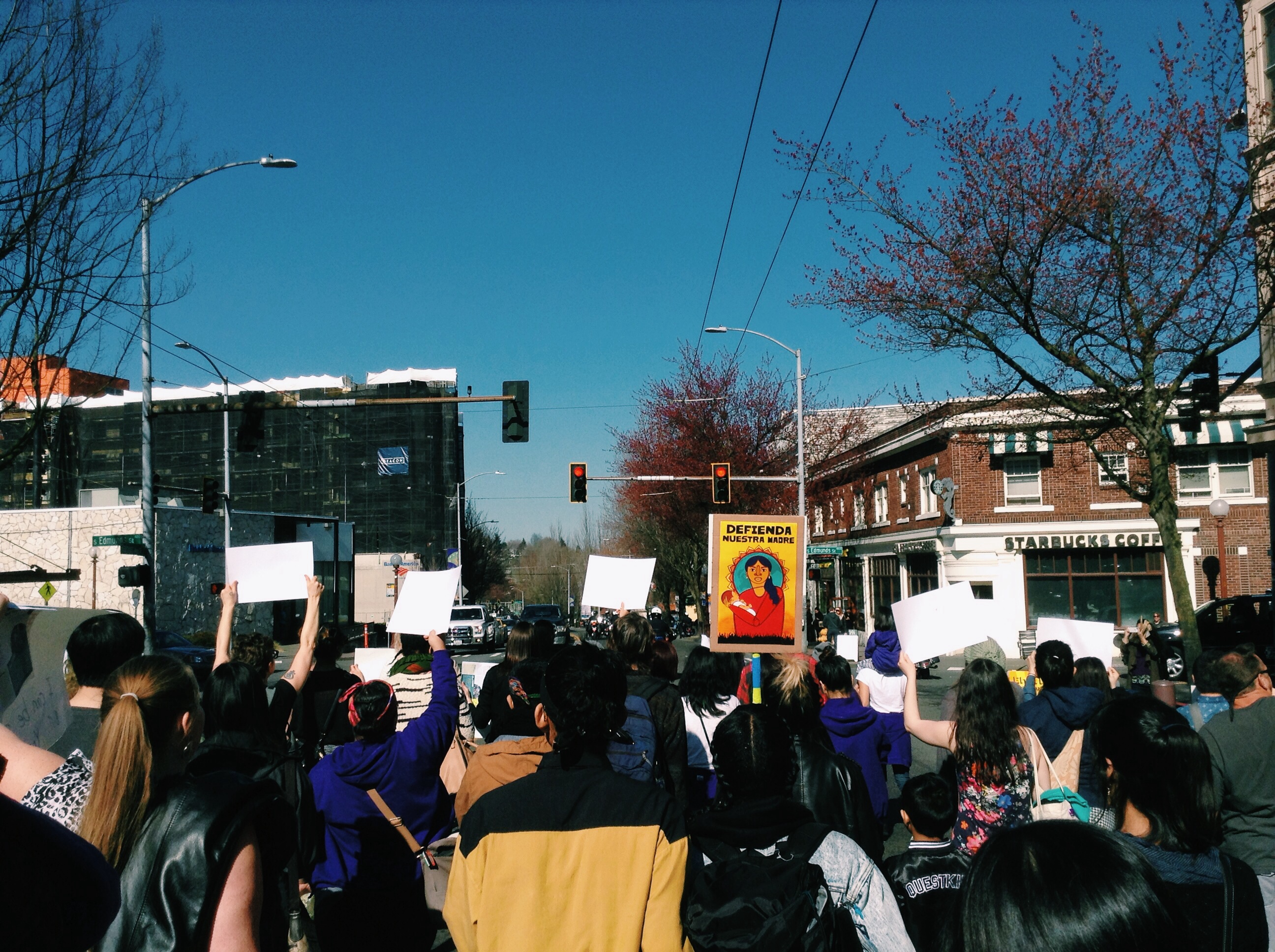 The amount of work and organizing that goes into something like women who rock is astounding. Everyone involved is a community organizer, educator, and/or activist. The people who attend want to see change in their community and enjoy discussing ways to make this happen. This is what makes the unconference so powerful. It’s fluidity and relaxed energy transforms the cultural center into a host of creative ideas. Community is powerful and women who rock, believes it. Every individual matters, their stories are important and need to be hear. Women of color are often ignored, excluded, and set in the background. Unconferences like women who rock place women of color at the forefront, making their identities and experiences valid and the star of the experience. Through these photos we can see the audience moving things forward, listening intently to the panel discussion and marching through downtown Columbia city chanting things like, ‘no justice, no peace, no racist police!’ And, ‘we want justice for all women’. All important and all powerful, without a leader, systems of oppression can not focus on just one individual and get rid of them. We are all leaders. We are all leading it. Community is powerful.
Group 15
WWR Media Justice
Several moving stories were told by the panel that just came up. Starting with the “No justice No peace” chants at the start you could tell this was gonna be a serious section. The best story, to me, was the girl from Mexico City that as an activist in Mexico would be tortured but never stopped and nowadays as an activist in the U.S. gets rewarded with great project jobs, awards, and praise. The next girl also has a very good story, and she can sing very well. She said “If you walk the talk, dream big, and inspire yourself…..” She can look up to you, which is dope because individuality is everything whether it be life in general, music, or a movement, without leaders and individuals with unique ideas nothing gets done progressively.
Sharon Maeda
An Asian American activista icon, right here on stage! She’s talking about doing the ground-level work and watching it being “undone” by the mainstream media. She’s talking about her important work with Pacifica Radio — a shout out to ‘Democracy Now!’. She says it’s important to “pay attention” to what’s going on and to find avenues for media justice — she says LPFM is the result of a long struggle. She says, “Whatever your issue is, media justice must be your second issue.”
Bringing street activism indoors!

Our panelist discussion moderators are powerful women of color activists working with women of color against systemic racism. They are leading a chant, ‘no justice no peace, no racist police’ and everyone is chanting along. This is power. This is movement. This is beauty. Aretha is one of the moderators; she is a student at UW Bothell and a strong outspoken ally who I have met at Black Lives Matter marches. Her words have always been uplifting and her actions have always been about strength. Seeing the papel picado and flores de papel surround the panelists creates an environment of safety and celebration. We are all celebrating our truths and the fact that we are all here together, sharing our experiences. Encouraging each other to change the world.
Group 15
 Women Who Rock