
Our altar is honoring those who have died crossing the border. As a group, we believed this was dear to our hearts because we have either experienced this in our own families or we know of others who have lost loved ones. As we explain to the community our altar, they also have shared their experiences of losing their loved ones. We come together this evening to cry, to laugh, and to make conversation. I have learned so much about people and have listened in on conversations being discussed about tonight, alongside my colleagues. As the Dia De Los Muertos event comes to an end tonight, I hope to continue to meet people and ask them about their altars and what it means to them.
El Desfile de Lxs Músicxs
Starting from a spontaneous session on the third floor, eight musicians collectively decided on chords and a rhythm and used this to lead a procession through the hallway of altars. There was a great variety of instruments traditional to Venezuelan fandango musical custom, including a charrasca, an animal’s jaw bone, used in a manner similar to that of a wood cricket. They lined up and performed throughout El Centro to their new auditorium where they broke into song and dance, and spectators received pan dulce and took a seat to watch. Many people, kids in particular, joined in in the dancing. The music was uplifting and positive, and the energy of the dancers and musicians alike was palpable. The musical tradition forms a central aspect of Día de los Muertos festivities.
Live Blog Post #1
Being surrounded by so many diverse people coming together in one space to celebrate el Dia De Los Muertos is a beautiful experience. I have never attended a Dia De Los Muertos event as my family and I didn’t celebrate it. Immersing myself in such an event and being able to participate in one as well has been an experience. As I walk through the hallway of the altars, there are so many people that are being honored. The overarching theme of this year’s Dia De Los Muertos is “Honoring Those Who Have Build Bridges Not Walls.” Through the altars we are honoring family members, friends, and so many other people that have not been forgotten. As a community we are coming together and celebrating a collective theme.
Los altares del Día de los Muertos en el Centro de la Raza
A great variety of colourful and dense altars line the walls beneath rows of papel picado, with full meals, bread, fruit, or candy placed out front, flanked by orange paper flowers and candles. In their remembrance of those who have passed away, the dedications made are varied and include the Tulsa Race Riot of 1921, Amnesty International, HIV/AIDS prevention, the 2016 Orlando Pulse shooting, as well as issues local to Seattle and directly personal to the people who have built these altars, such as the level of pollution and noise in Beacon Hill, the Washington Coalition to Stop the New Nuclear Arms Race, and Somos Seattle, an LGBTQ Latino organization. The altars concern themselves with the remembrance of the past, who and what has been lost, as well as the continued struggles of the present and the potential for a more equitable and peaceful future.
Live Blog #2
We’re having this amazing and once in a lifetime opportunity to have Caye, Black Mama, Taki Amaru, and Jeka Libre perform before our eyes. They are rapping and speaking so loudly with words that would otherwise make you feel uncomfortable. They rap about young girls getting raped and molested, they speak about abortions and how disgusting men have been. They are speaking words into existence. Words that have been silenced by men and society and those who constantly tell us to be quiet because we are being “lloranas.” They are empowering us with their words, their pain and their energies.
Live Blog #1
We are here once again in Quito Ecuador, at the event Feminista Hip Hop/Futurismo Feminista: Encuentro & Dialogo with Cayetana Solano also known as Caye Cayejera and Ana Gabriela Cano also known as Black Mama on stage. They have brought two new guests, Taki Amaru, a Kwicha rapper and Jeka Libre. We have continued the conversations we started in class. One of the things that have stuck me the most since the event started was what Taki has shared with us. “Sumak Kawsay es muy ponderosa…es aprender a vivir en harmonia, con las energias que ni si quiera son solo con nosotros de humanos, es entender que hay energias que bajan des de los cosmos, que asienden de la tierra, y poder vivir con plentitud con eso.”
English Translation:
Sumak Kawsay is very powerful… it’s learning how to live in harmony, with the energies that are beyond human, that come from above and below earth, and being able to live fully with that.
Wooo!
It was such an honor to have the performers share their music with us here in Quito, Ecuador at the Dommo Cultural Platform, as part of the event Feminista Hip Hop/Futurismo Feminista: Encuentro & Dialogo. A perfect way to end the night, everyone had a blast listening and dancing to such powerful music! -Porter


Women Who Rock: Quito, Ecuador Encuentro
Live Post:
At the encuentro, the panelists are now answering questions and talking about their own experiences as rappers and women. There are also now three dogs at the event. Caye just asked Jessica how the other hip hop artists reacted to her being a part of that group, and how Jessica responded to their reaction. Jessica says (with Ana Gabriela aka Black Mama translating) that the reactions were different because they were all girls going up on the stage using “big words with big mouths.” Some guys were supportive, but it was hard. Black Mama then said that the women in that group made a path for women in hip hop, allowing for a new role for those women. Now, those women get to have their own crews, and Jessica is going solo.
Black Mama then spoke to her experience at a rap battle where she battled 80 men. After, she received death threats, and other women told her that those threats are the reason to not go to the battles, to stop rapping. Black Mama received rape threats, was booed and yelled at, and nearly gave up hip hop. She thought about leaving, but didn’t want to lose the ability to be heard, although she is still facing consequences from that show. But in her own words, “I keep on rapping, and nobody gonna stop me.”
Anger in Hip Hop
At the event Feminista Hip Hop/Futurismo Feminista: Encuentro & Dialogo, Ana Gabriela Cano speaks to the anger and the passion in her music. She says the anger stems from the injustices she and others experience. It’s the anger that makes her “want to say something, need to say something.” Very powerful conversation happening here in Quito Ecuador, at the Dommo Cultural Platform. -Porter
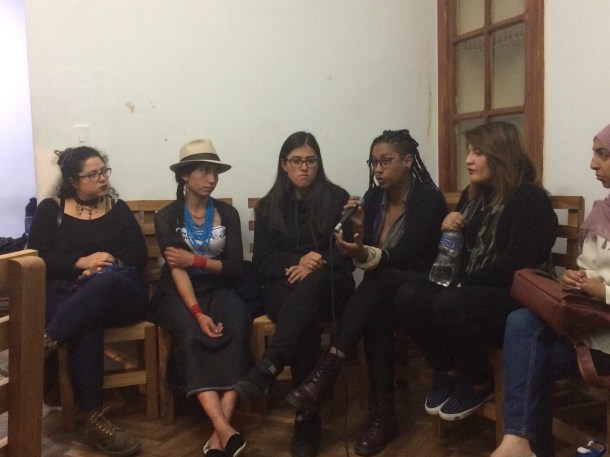
Women Who Rock: Quito, Ecuador Encuentro
Live post:
After a round of introductions from everyone in the circle, the rappers began talking about their music as well as other feminist programs. Taki Amaru is a rapper who raps in Kichwa to bring to light discussions about indigenous people all over Ecuador. We had a chance to meet Caye before and hear about her project, Women Behind the Camera. During her introduction, Black Mama talked about how she had been fighting for racial rights, but upon meeting Caye, she took on a broader fight for women’s rights. She also said that when she met hip hop she found a way to reach more people, people who needed this message, and has met others in the hip hop world to rap with and also work with for a cause she believes in. When Jessica introduced herself, she spoke about her projects in both music and graffiti. She was also part of the first women’s hip hop group in Quito, and is now working on a solo project. After brief introductions, the rappers began talking about how they met and admired each other at concerts, and it was inspiring to me not only to see these women supporting each other but the way they want to fight for and uplift other women of all backgrounds.
 Women Who Rock