
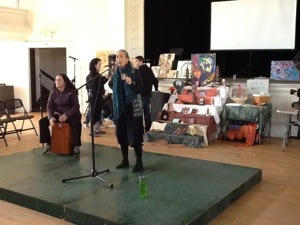
Just a few minutes from now, we’ll hear these two amazing women in performance!
Rock the Archive – Creative Source Panel with Gretta Harley, Sheila Jackson H., and KItty Wu
INTERVIEW TRANSCRIPTION
Moderator: Angela Macklin
Gretta Harley: She began speaking about the work of Home Alive and the two films that have emerged about the organization. Work interested in looking at how women have been left out of the archive of history of grunge. The Women Who Rock archives have given their support for the interviews she has been doing with women. Currently, she has a play THE STREETS on stage in Seattle; a non linear play that focused on women’s contributions to the grunge scene.
Sheila Jackson H.: Still in production on NICE AND ROUGH. Film has been a journey; as I uncover more and more black women in rock, discover that they are all over the world, not just in Los Angeles. About a year ago, hit a funding wall, and discovered the need to expand the scope of the project. Wish to see black women in rock get recognition as established figures in rock. Established a website “niceandrough.com” where people can go to learn about the scope of the music produced by black women in rock. The typical number people imagine of black women in rock is 5, at most 25, when in actuality the numbers are much greater and need to be documented. NICE AND ROUGH still unfolding as a mission, a lesson that shows we all want the freedom to be who we are and to do our art regardless of race.
Kitty Wu: I feel a lot of parallels with both of you. I work for 206Zulu here in Seattle. I’ve been working with many collaborators around archiving work in Seattle. I’m happy to be here. We have about 750 episodes with a lot of footage of people and shows that we are working to put into the archive. Being here in the building with the space to create is an incredible thing and want to encourage people to create.
Macklin: There’s always the question of where do you store your work and who’s going to house it. There’s also the issue that for every hour that makes it into the archive, there are about 60 hours that don’t. Can you talk about the experience of doing the interview?
Harley: A lot of the women we have been interviewing do not have a presence on the Internet. We have a site, “thesestreets.org” in which there are pages and links; archiving is an incredible asset we have that we didn’t 20 years ago, when remembrance was not even part of the process. Right now we are dealing with raw footage and Wes Hurley has been releasing 3 minute clips on TheProjectRoom website. We feel we are at the beginning of a project. Each interview is about an hour long; we work to keep the interview footage as whole as possible.
Sheila: Editing is such a daunting process. Before I first began and conceptualizer documentary, I went though an outline of my anticipated outcome. Kind of a double edged sword. You can look at your expectations but the outcome leads to something else. I try to keep my vision but remain open at the same time. when I look at the interviews, I try to think what part of the journey of women in rock that the interview belongs to. I’m excited about the aspect of just staying open to the stories that unfold through the interviews.
Kitty: Technically what we do when we make a show is pick out a sentence or paragraph. For the documenting, we were lucky to get some funding.
Angela: Each of your projects have a community building component.
Harley: When I was growing up there wasn’t a lot of role models; the goal is to create those for the next generation.
Shelia: important to be reflective and document what does not presently exist; so important for us on a spiritual and psychology level for us to see ourselves reflected in the media. So many of the women feel that they are alone in their work. To me, the healing is in putting out the stories.
Kitty: the community component is in the consumption and why audience is so importance.
Angela: Please follow the websites of each of these presenters. Thank you all for the work you are doing and we look forward to seeing all of your work in the women who rock archives.
Archive as Creative Space
Gretta Harley, Sheila Jackson, and Kitty Wu are talking about film-making and/as archiving. They are filming people and communities who have been left out of documentation–women in grunge, black women in rock, for example. Angelica Macklin is asking how the film-makers exercise their creative decisions when watching a long interview, only a small part of which can go into the film. How do they think about how to archive the rest of the material. Listening is so important, I hear as a theme, openness, understanding that a plan shapes what you bring to it, but you need to be open to changing direction.

Sheila says that archiving has become a significant part of her project. The topic is bigger than she thought, even bigger than the women she is interviewing for the film realized. Community-building, representation, recognition and archiving all connected for all three of these fil-makers.
Michelle + Sonnet introduce the WWR Archive!!
Michelle: “Creating the conditions of possibility for new kinds of stories and imagined communities.”

Michelle and Sonnet Launch the Archive
I am tremendously moved by the launch of this beautiful accessible archive. So many people have worked so hard to make this all happen.

Rocking the archive.

Sherrie Tucker + Sheila Jackson H. add some sway to the archive.
Still from WWR Film Fest

Inspirational reflections on activism and imagining change.
WWR Rocks Film
Excerpt from the fantastic WWR Film Festival. Amazing + inspiring work. Who needs a film school?
Working the space between
Thinking there’s something very productive in the space between. From the archive workshop.
Women Who Rock Film Festival & Oral History Archive Launch
MC Christa Bell opens the event. The film festival features work created for the Women Who Rock Digital Archives. (see detailed overview below)
Michelle Habell-Pallan and Sonnett Retman, the cofounders of the Women Who Rock Conference, unveil the launching of the Women Who Rock Digital Archives, featuring the first set of interviews, 13 oral histories, with 16 more forthcoming and more forthcoming after that. “It’s not just an archive of the past, but an archive of the future, and an archive of possibility,” says Habell-Pallan. They have divided the archives into various categories that include people who work on stage, behind the scenes, and make work. Retman added, “Many of the interviews were conducted by the network of people involved in the making of community here in Seattle.”
THE FILM FESTIVAL-OVERVIEW OF FILMS
In the first film, we see archival footage of various female music groups and hip hop artists who have played at Washington Hall. They spoke about the importance of the archive and the documentation of the conversations about power and control, opposition and resistance, taking place through music.
The second short film we see is about the Century Ballroom on Captial Hill and its founder and owner, who began the space out of her love for swing dancing. She started partner dancing and wanted to create a place where people could take queer dancing classes. She spoke about the power of the space and the positive ways it works to break down gender barriers. “We’ve created an open environment…it’s a group effort to do events.” She spoke about the ways dance works to stave off dementia.
The next film was by a filmmaker named Barmi who creates documentaries to look at the history of communities of struggle, beginning with her own Somali community; her filmmaking is rooted in the tradition of Somalia storytelling, using digital filmmaking to expand the frame of the narrative. She spoke of the work she is most proud of: usually a story of a person’s transformation in a way that anyone can relate to it, stories of people making change in their community. “I’m serving the community, but also part of the community.” Her goal is to empower more people to use digital media art to document the community.
The fourth film featured “Militant Child” who began work with spoken word and evolved to hip hop poetry. Labeled her music and reflections under the naming “militant child” to capture the inspiration for her work beginning with her readings of movement leaders, such as Malcolm X, and artistic influences from Tupac. “I try to model my own art in that way . . . not cutting myself off from the people I am trying to reach.” Which is why she sees poetry and hip hop as such potent vehicles for delivering political work.
The next film looks as Monica Royas and her work in Seattle with the De Cajon Project. Interview comments give testimony to the force of her work to unify people. She works to create musical encounters that mirror what is happening in her native Peru. (See my blog on the Welcoming Comments for 2013 Women Who Rock featured Monica Royas.)
The following film looked at female drummer, Frank Stankevich. She spoke about the ways she is constantly defying the expectations of female musicianship by entering a space to play the bass drum rather than the expected smaller instrument, like bongos. She closed by encouraging women who have thought about playing drums to start.
The next film was on “queering the campus” and featured many students. It includes footage of the double consciousness poetry jam showcasing work that gives testament to the struggles queer students face in coming into consciousness about who they want to be in the world and the pressures and challenges posed by the expected norms of family and community.
Next presentation was “Cycles of Change,” a music video by Quetzal featuring Nobuku Miyamoto, directed by the fabulous visual artist Dan Kwong.
“Now Promenade Right at Home” – Charmain Slaven, of the Tailboys. speaking about her investments in old time music. Brittany Nettle, also featured, spoke of her playing of Bluegrass music. We see footage of the dance halls where they have played, with Slaven speaking about how the squaredancing, call, dancers and band work together collaboratively at the performance events held in the dance halls.
Next work is a film about Star Nayea, Native American singer, writer, recording artist; a 2 time Grammy artist. This short work provides a glimpse into the work she has produced and her philosophy about making music.
The next film documents this year’s Grammy with the nomination – and award — of Martha Gonzalez and Quetzal playing “Fuego.” The transnational work of music to disrupt and the using of the Grammy to subvert what they represent.
 Women Who Rock