Download film festival and conference program here: Women Who Rock: Making Scenes, Building Communities Conference Program
or

or
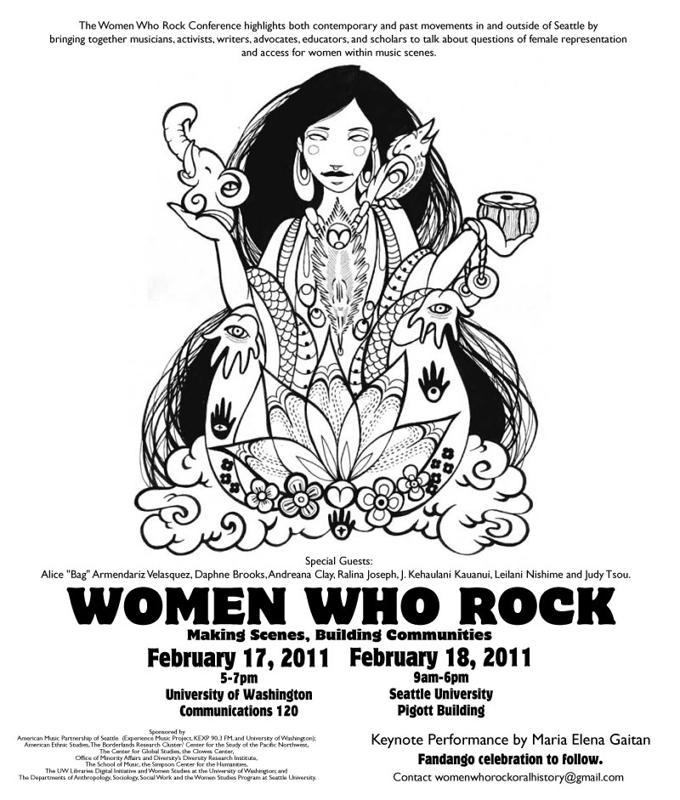
Women Who Rock: Making Scenes, Building Communities Film Screen and Conference, Thursday February 17, UW and Friday February 18, Seattle U
All events are free and open to the public. Register at https://catalyst.uw.edu/webq/summary/quetzal/111906
Thursday film screening: “Women Who Rock! Making a Scene On and Off Screen.” 5 to 7 pm. University of Washington. Communication 120.
Friday Keynote Performance. “The Arts and Healing: The Road to Wellness Through Truth-Telling and a Song” Musician/Performance Artist, Maria Elena Gaitan “Chola con Cello.” 4:30-‐6:00pm. Seattle University. Pigott Atrium.
Fandango/Community Music Celebration. 8-12pm. Seattle U. Vashon Room. Bring your instruments!
We invite you to participate in the Women Who Rock Conference: Making Scenes, Building Communities, February 17-18, at the University of Washington and Seattle University.
We convene because the music calls us. Women have been a powerful force in Seattle’s well-known independent music scene, as performers, promoters, writers, DJs, archivists and fans. In many cases, they embody the hybrid identity of artist-activist-advocate. Historically, in the Pacific Northwest, women have used their music and activism to create music scenes that anchor social justice movements. The present is no different. The Women Who Rock Conference, organized by the Women Who Rock Research Project and the Women Who Rock Graduate Student Collective, highlights both contemporary and past movements in and outside of Seattle by bringing together musicians, activists, writers, advocates, educators, and scholars to talk about questions of female representation and access for women within music scenes. We have been particularly inspired by the ways that Chicana and Black feminist thought has expanded who counts as “women” and what counts as “rock.” In staging these conversations about women and music, we hope to build community and make our own scenes in the process. Though these conversations may prove to be challenging at times, we are committed to them nonetheless.
CONFERENCE STRUCTURE
The conference runs for two days. On Thursday, February 17, following a workshop format, a small group of scholars will respond to works-in-progress centered around feminist thought and music presented by graduate students from the University of Washington and Seattle University. The conference then welcomes all participants to attend a film festival facilitated by Angelica Macklin. On Friday, February 18, conference goers will attend topic-focused breakout sessions that include a broad range of participants. Here, we’ve experimented with a conference structure that emphasizes dialogue. In a departure from traditional panel sessions, participants will briefly introduce their topics and then open up conversations that engage the diverse audiences present at the conference. Later, we will meet as a large group to synthesize our conversations. At the close of the conference, performance artist Maria Elena Gaitan will perform and that night, we will convene an open mike ni!
ght and Fandango gathering.
ORAL HISTORY ARCHIVE
The conference responds to the ways in which women’s participation in independent scenes has often been downplayed or unacknowledged. We are currently assembling the Women Who Rock Digital Oral History Project to archive the stories of women and women of color who have built community through the making of music in Seattle, the Pacific Northwest and beyond. The archive will be hosted by the University of Washington and made freely accessible to the public.
To ensure a seat, please register at: https://catalyst.uw.edu/webq/survey/quetzal/111906
For program: https://womenwhorockresearchproject.wordpress.com/
For more information please email us: womenwhorockoralhistory@gmail.com.
Best,
Mako Fitts
quetzal flores
Michelle Habell-Pallan
Sonnet Retman
Women Who Rock Graduate Student Collective, including Nicole Robert, Kim Carter Munoz, Monica de la
Torre, Martha Gonzalez, Kate Mottola, Noralis Rodriguez, Georgia Roberts, and Schuxuan Zhou
Conference co-organizers
To ensure a seat register at: https://catalyst.uw.edu/webq/survey/quetzal/111906
“Women Who Rock: Making Scenes, Building Communities”
February 17-18, 2011 at the University of Washington and Seattle University Call for Session Proposals Deadline: November 30, 2010
Women have been a powerful presence in Seattle’s well-known independent music scene, as performers, promoters, writers, DJs, archivists and fans. In many cases, they embody the hybrid identity of artist-activist-advocate. Historically, in the Pacific Northwest, women have used their music and activism to create music scenes that anchor social justice movements. The present is no different. The Women Who Rock Conference, organized by the Women Who Rock Research Project and the Women Who Rock Graduate Student Collective, will highlight both contemporary and past movement(s) in and outside of Seattle by bringing together musicians, activists, writers, advocates, educators, and scholars to explore questions of female representation and access for women within music scenes. This conference is intended to reach an academic and public audience. Scholars and educators will contextualize their explorations of women within various music scenes by engaging broader discourses of feminist, critical race, and class analyses. Musicians, activists and others will demonstrate how innovations in the
creative arts link to social justice movements.
Photo of Sister Rosetta Tharpe, ca. 1930, © Michael Ochs Archives/Getty Images 1970
This conference, which aims to be an annual event, will also introduce the initial phase of the Women Who Rock Oral History project. At the conference, we will generate contacts for future oral histories.
We invite activists, scholars, musicians and artists to submit proposals for topic-focused breakout sessions that will promote dialogue about women, music, and social justice, taking into account issues of gender, race, ethnicity, class and sexuality. We encourage session proposals that explore the ways that Chicana and Black feminist thought have expanded “who” counts as women and “what” counts as rock. In your session proposal, please include the names of facilitators, participants and/or performers; a short description of your topic; a list of the key points you would like to address in dialogue with conference attendees; and a plan for how you will address them. Group and individual session proposals will be considered. We move away from traditional panel sessions with the aim of promoting dialogue. We are particularly interested in creative, non- traditional, and/or musical session formats.
Possible topics include, but are in no way limited to:
Performing Community:
Photo of Alice Bag, ca. 1978, © Ruby Ray 1978
• The role of music scholars, critics, performers and archivists as well as Chicana and Black feminist theorists in crafting a feminist narrative of hip hop, punk, and indie rock
• Women performers and the art of DJ-ing, breakdancing, rhyming, graffiti art, vocalizing and spoken word • Building community at the intersection of Hip Hop and Indie Rock • Autonomous women-focused art collectives (ex. Mujeres de Maíz) • Queer musical practices and interventions
Making a Scene:
• Music making as a local site of feminist community-building (examples include Home Alive, B-Girl Bench, Seattle Fandango Project and others)
• The role of performers, advocates, and educators in creating musical communities • Creating a space for building connections between women in hip hop, indie rock/punk, and alternative rock
cultures that share a similar ethos but rarely connect
• Connecting the women who use music culture as a platform for pleasure and politics • Linking local music communities and transnational musical movements (de CAJóN Project , Afro-Peruvian percussion)
• Musical and creative responses to immigration debates (SB 1070) • Creating spaces of autonomous music making and sharing
• The role of community radio • Internet and social networking
Communal Archives/Oral Histories:
• The politics of the archive; the archive as a site of community-making and historical praxis • The archive as resource for performers, advocates, and scholars • The archive as foundation for digital online and museum exhibits • Presentation of oral histories
Collaborative networks of production, performance, and distribution:
• Use of digital technologies for in-home production and recording • Use of digital technologies for musical and scholarly collaboration • Music communities as a vehicle for public humanities
Please submit your session proposals by November 30, 2010. Proposals should be 500 words or less and include a description of the session format. Please also include a 50-word biography. Send proposals for sessions to quetzal@uw.edu. Group and individual proposals or performances will be considered.
Questions? Contact Quetzal Flores, quetzal@uw.edu.
Conference registration at: https://catalyst.uw.edu/webq/survey/quetzal/111906
Conference organizers: Mako Fitts (fittsm@seattleu.edu), Quetzal Flores (quetzal@uw.edu), Michelle Habell-Pallan (mhabellp@u.washington.edu), Sonnet Retman (sretman@u.washington.edu), Nicole Robert (nrobert@u.washington.edu ), Georgia M. Roberts (gmr2@u.washington.edu).
This conference is co-sponsored by the American Music Partnership of Seattle (Experience Music Project, KEXP 90.3 FM, and University of Washington), Women Studies, American Ethnic Studies, School of Music, and the Simpson Center for the Humanities at the University of Washington as well as Anthropology, Sociology, Social Work, and the Women Studies Program at Seattle University.
To download pdf version, click https://docs.google.com/fileview?id=0B8pkiYSOby_lZjU0ODlkODgtODMyOS00MDEzLWFiZjktYTM4OWZhZmVjYzlh&hl=en
Welcome to WordPress.com. This is your first post. Edit or delete it and start blogging!
 Women Who Rock