

INVITATION TO “ROCK THE ARCHIVE”
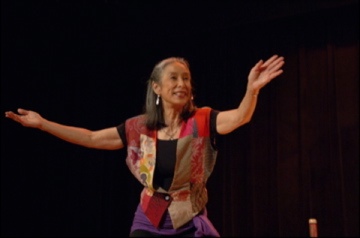
Nobuko Miyamoto
When Nobuko Miyamoto began writing music 30 years ago, there was virtually no such thing as Asian American music. In 1973, together with Chris Iijima and Charlie Chin, “A Grain of Sand,” she created the first album of Asian American music, now part of the Smithsonian Institution collection.Since 1978, Nobuko has been Artistic Director of Great Leap, Inc., a non-profit arts organization which uses the arts to promote deeper understanding between the diverse cultures of America. Some of her works include musicals such as “Chop Suey,” “Talk Story,” and “Joanne is My Middle Name,” short film “Gaman” and video, “A Gathering of Joy.” She also produces “A Slice of Rice, Frijoles and Greens,” a touring multicultural theater production.Nobuko began her career as a dancer in film and Broadway musicals such as “West Side Story,” “The King and I” and “Flower Drum Song.” Music has always been at the core of Nobuko’s work. She co-produced her second album “Best of Both Worlds,” as well as the album, “Dini Clark Sings Duke Ellington.” She has also worked on the other side of the camera when her song “Yuiyo” and choreography were in the film, “Karate Kid II.” One of her songs is part of a HBO children’s show called “Happily Ever After.”Nobuko’s belief in the power of art to transform self and society propels her to continue to perform in concerts of her music. She also tours her one-woman show, “A Grain of Sand,” to colleges and theaters across the country. “A Grain of Sand” shares her personal journey to find and follow her inner voice.Nobuko currently gives lectures, teaches workshops, and leads residencies across the country. She has taught several courses of “Finding Your Own Voice” at UCLA with the Asian American Studies Center and lectures on her “Journey of Art Making, Activism and Creating Community.” Recently, Nobuko collaborated with the Liz Lerman Dance Exchange in the Los Angeles “Hallelujah Project,” presented by the Skirball Cultural Center. She is the Artistic Director of the To All Relations residencies in Phoenix, San Jose, Detroit, Watts and Boyle Heights.Nobuko’s album, “To All Relations” was released in 1997 and the reissue of “A Grain of Sand” was re-issued in CD format in 1998. Both are available on Bindu Records.
THE UNCONFERENCE AND FILM FESTIVAL
We invite activists, scholars, musicians, filmmakers, and artists to gather for a celebration of the launch of the Women Who Rock Oral History Archive. The day-long launch will include: a participant-driven (un)Conference centered on dialogue about women, music, and social justice scenes; a community bazaar; children’s activities; a film festival featuring shorts on women in the archive; a keynote session with esteemed performer and long-time activist Nobuko Miyamoto; a conversation with Gretta Harley, Kitty Wu and Sheila Jackson H.; an evening open mic hosted by Youth Speaks and Feest; and a Fandango hosted by the Seattle Fandango Project. Taking into account issues of gender, race, ethnicity, class and sexuality, our goal throughout the day is to expand on “who” counts as women and “what” counts as rock. Guest scholars: Tiffany Lopez, Tara McPherson, Sherrie Tucker, Deborah Vargas, and Deborah Wong. The full schedule of activities is listed below.This gathering and celebration is built on your creative participation: submit an unConference conversation sessions: propose a workshop sharing session/conversation/convening of ideas; reserve and host a table at the bazaar; represent your org(s), activism(s), or student group(s), sell t–shirts, CDs, art, share info, paint, draw, dance, laugh, cry, make music – and also participate in the evening community open mic and Fandango.
INVITE YOUR FACEBOOK FRIENDS: http://www.facebook.com/events/390236164401029/?fref=ts
SCHEDULE – SATURDAY, MARCH 9
11:00-12:00 Registration (plus sign-up for conversations/skill-shares/diálogos).
12-12:30: Opening (LIVE MUSIC) Monica Rojas and deCajón, Afro-Peruvian Percussion, Song & Dance!
12:30-1:45: unConference: Please be prepared to lead or co-lead your proposed conversation/skill-share/diálogo.
12:30-1:45: For children. Mottainai dance workshop with featured guest Nobuko Miyamoto. Childrem who participate in workshop with perform with Nobuko during her keynote. See video for Nobuko’s Mottainai dance @ mottainai.greatleap.org.
1:45-2pm: Cake Break
2:00-2:40 Action/Speak out/Sing out/Dance out: Each group will have several minutes to share regarding the outcomes of the conversations/skill-shares/diálogos.
3:00-4pm: Women Who Rock Film Festival & On-line Oral History Archive Launch.
4:00-4:30pm: Rock the Archive: Archive as Creative Source Panel” featuring Gretta Harley of Home Alive and These Streets, Sheila Jackson H. film director of Nice and Rough, and Kitty Wu of 206Zulu.
4:30-5:20 Keynote Speaker Esteemed Performer and long-time activist Nobuko Miyamoto of Great Leap. Conversation & Mottainai Circle Dance.
5:30-6:30pm Dinner Break–please bring cash for food vendors.
6:30pm-8pm Open Mic organized by Lulu Carpenter.
8-10pm Fandango with Seattle Fandango Project.
***Arts Bazaar throughout the day
***Community Altar
***Guest speaker Nobuko Miyamoto will conduct a children’s dance workshop from 12:30 to 1:45. Children in dance workshop will be invited to perform with Nobuko during her keynote.
UNCONFERENCE CALL FOR CONVERSATION IDEAS
KEYWORDS
The “Rock the Archive” unConference is participant-driven and open to all present. This event transforms conventional ways of gathering. It is multi-genrational. By structuring the conference around participant interest and this year’s theme of “Rock the Archive,” we set the stage for dynamic conversations and chance encounters. We ask people to propose topics for conversations/skill-shares/diálogos around this theme. To archive is to collect, record, file, document, and create artifacts for the purpose of telling our stories and crafting our histories. So we want to hear about how you and your communities, movements, organizations, and cultural scenes are documenting your stories, processes, and sharing the work that you do. Why is this important? We are all engaged in social change work. By documenting and making sense of what we do, we can share strategies, remember the past and change the future. What do you want people now and in the future to know about your organization and your work?
Examples of Possible Topics:
-
preserving D.I.Y. cultural history and/or music across styles/scenes
-
preserving the cultural history of undocumented immigrants (HB1070)
-
histories of queer and feminist organizations
-
youth spaces
-
healing through storytelling
-
developing skills for documenting and managing your organization’s work
-
our bodies as our own archive of our work
-
theatre/movement/dance – community-building activity
-
preserving ways of being together (through food, music, dance, conviviality)
-
preserving and enacting convivencia through music, dance, art
HOW TO SUBMIT YOUR IDEAS FOR A CONVERSATION
If you are interested in leading or co-leading an unConference conversation/skill-share/diálogo, please submit the following information by leaving a response to this post in the box below. By leaving a reply with your information, your conversation/skill-share/diálogo will be displayed for browsing so that others with similar interests might find you. If you see something already posted that is similar to a topic you would propose, you may propose combining your idea with that topic. All proposed topics will be posted at Washington Hall the morning of the event so that participants can make choices of what to participate in as they arrive and register at the unConference. Depending on the number proposed, conversations/skill-shares/diálogos will creatively share space within the unConference site of Washington Hall.
1. Your proposed conversation/skill-share/diálogo
2. Your name and affiliation
3. A brief summary (100 words max) of your proposed conversation/skill-share/diálogo
4. Please note that this year we will not be able to provide data projectors. We will however provide papers and pens if requested.
5. Please try to have your proposed conversation/skill-share/diálogo posted by Feb. 21st
PARTICIPANTS, SPECIAL GUESTS, AND ORGANIZERS
Tami Albin is the Faculty Outreach and Instruction Librarian and liaison to Women, Gender and Sexuality Studies at the University of Kansas. She is the Director of “Under the Rainbow: Oral Histories of GLBTIQ People in Kansas.” Her goal is to become an amateur ghost hunter specializing in haunted libraries.
Christa Bell – 2013 Women Who Rock unConference MC – Educator, performer, and UW graduate student in Masters of Cultural Studies Program
Luzviminda Uzuri Carpenter (pronounced Loose-b-min-dah ooh-zir-e car-pen-ter) aka Lulu, works for Historic Seattle as the Caretaker at Washington Hall and a Co-Coordinator at the Racial Disparity Project of The Defenders Association. In 2008, she founded Uzuri Consulting & Productions and a collective called Green Bodies with other fierce womyn of color and KnowMades (a youth solidarity organization). She serves on community advisory boards, such as Women Who Rock Community, Zenyu Healing and Allyship. Carpenter has worked with Hidmo, Ladies First Collective Organizing Committee (an anti-rape collective), Pinay sa Seattle-GABRIELA around issues of art & cultural work to support movements. Carpenter has built trainings, programming & curriculum with womyn of color, trans & queer, and LGBTIQ communities around intersectional oppression, intimate partner violence, sexual violence, and transformative justice within the Asian Pacific Islander Women and Family Safety Center, Communities Against Rape and Abuse (CARA) and recently through YouthCare. She has honed her passion and skills for working with “marginalized” youth including formerly incarcerated, gang affiliated, trafficked, homeless, immigrant, & refugees for the past 8 years through the following organizations: YouthSource, YouthCare James W. Ray Orion Center Drop-in & Outreach Team, Franklin High School Political Science & Public Service Academy, the Service Board,Seattle Young People’s Project, and Seattle YouthSpeaks. As a bridge builder & community organizer, Carpenter believes in the power of art & cultural work to heal & transform lives individually & collectively.
Monica De La Torre’s scholarship bridges New Media and Sound Studies by analyzing the development of Chicana feminist epistemologies in radio and digital media production. A member of Soul Rebel Radio, a community radio collective based in Los Angeles, Monica is specifically interested in the ways in which radio and digital media production function as tools for community engagement. She is an active member of the UW Women of Color Collective and the Women Who Rock Collective. Monica earned a B.A. in Psychology and Chicana/o Studies from University of California, Davis and an M.A.in Chicana/o Studies from California State University, Northridge; her master’s thesis was entitled “Emerging Feminisms: El Teatro de las Chicanas and Chicana Feminist Identity Development.” Monica received a 2012 Ford Foundation Predoctoral Fellowship, which recognizes superior academic achievement, sustained engagement with communities that are underrepresented in the academy, and the potential to enhance the educational opportunities for diverse students.
FEEST is the Food Education Empowerment and Sustainability Team! We are a youth-driven improvisational cooking program. We eat together family-style while learning more about food and its impact on our selves and our communities. FEEST creates possibility by bringing young people to the table to cultivate their leadership and advocacy potential.
Dr. Michelle Habell-Pallán is an Associate Professor in Gender, Women & Sexuality Studies and Adjunct in the School of Music and Communication at the University of Washington. She authored Loca Motion: The Travels of Chicana/Latina Popular Culture (NYU Press) and coedited Cornbread and Cuchifritos: Ethnic Identity Politics, Transnationalization, and Transculturation in American Urban Popular Music (WVT, Germany); and curated award-winning and currently traveling bilingual exhibit American Sabor: Latinos in U.S. Popular Music, hosted by the Smithsonian Institution’s Traveling Exhibition Service (SITES) @ americansabor.org. She co-facilitates the UW Women Who Rock Oral History Digital Archive @ womenwhorockcommunity.org.; and builds community music with the Seattle Fandango Project. Her most recent article “‘Death to Racism and Punk Revisionism’: Alice Bag’s Vexing Voice and the Unspeakable Influence of Canción Ranchera on Hollywood Punk” appears in Pop When the World Falls Apart: Music in the Shadow of Doubt (Duke University Press, 2012) and her new manuscript Beat Migration: Transmediating Chican@ Music for the Digital Humanities is in progress.
Gretta Harley – A classically trained pianist, Gretta was playing music during the grunge years in bands Maxi Badd, Danger Gens, Eyefulls, and in solo performances in clubs all over Seattle and nationally. She co-founded the organization Home Alive and co-produced its first record on SONY Records. She began teaching, writing and directing music at Cornish College of the Arts shortly after earning a composition degree there 10 years ago (a severe hand injury took her out of the playing arena for 7 years). She has written and directed music for productions at Intiman, Seattle Shakespeare Company, Wooden O, Hugo House, the Tribes Project and dozens of productions at Cornish. She co-conceived of and co-wrote “These Streets” (with Sarah Rudinoff and Elizabeth Kenny), a theatrical play they call a Rock ‘n Roll Story: the untold story of female musicians of the grunge era;” and historic addendum adding women to history. (http://www.thesestreets.org) Gretta is half of the music project, We Are Golden, who plan to release a full length release of new music on Fin Records summer 2013.
Elke Hautala – An identical twin, wife, actress, singer and now scholar at UW and video creator –a former Seattle Underground tour guide, she recently appeared on Anthony Bourdain’s TV show The Layover. She is currently working on a short documentary film on women in lucha libre for her thesis.
Yesenia Navarrete Hunter is a Mexican mother who lives in Yakima with her family. She was born in Mexico and came to the United States when she was just a little girl. Yesenia is number 13 of 17 children and traveled with her family as migrant farm workers. Her passion for her art and her writing comes from sharing stories with her children. Her life is filled with love, laughter and lots of grace. Yesenia is a student with aspirations of earning a degree in family studies and education. She lives with her husband and children in Yakima, Washington.
Sheila Jackson H. is an award-winning Writer-Producer who began to explore the subject of Black Women IN Rock out of her love for honest, raw, and soulful music. She is the Director and Executive Producer of Nice & Rough, a multi-platform project that includes a documentary, concert tour, niceandrough.com(the online community) and more – all designed to celebrate the women who put the soul in rock n’ roll.
Carrie Lanza – 2013 Women Who Rock unConference Organizer. Carrie is a doctoral candidate in Social Welfare at University of Washington School of Social Work and a member of Seattle Fandango Project. Her work explores participatory arts and media production in community-based practice and research. She teaches in the School of Interdisciplinary Arts and Sciences at University of Washington, Bothell.
Dr. Tiffany Ana López is Professor of Theatre and Tomás Rivera Endowed Chair in the College of Humanities, Arts and Social Sciences. She has over twenty years experience working to foster dialogue and programming about Latina/o literature, drama and performance. As a hybrid scholar and artist, her research, teaching, and creative activities focus on issues of trauma and violence and the role of the arts in community building. Among her publications, she is editor of the anthology Growing Up Chicana/o (William Morrow & Co., 1993) and Chicana/Latina Studies: The Journal of Mujeres Activas en Letras y Cambio Social (2005-2012). She has also published in numerous books and journals, including Aztlan; Theatre Journal; Art Journal; Frontiers; Prose and Cons – Essays on Prison Literature in the United States; and The Blackwell Companion to Twentieth-Century American Drama. Among her awards, Dr. López is a 2004 Fulbright Scholar to Spain and the recipient of grants from the Ford Foundation and Rockefeller Foundation for her work on intellectual diversity and the creative arts. She is a member Campus Women Lead, and her work with students has been recognized by a Chancellor’s Award for Excellence in Mentoring Undergraduate Research (2009). She is presently working on a monograph with visual artist Barbara Carrasco and completing a book project, The Alchemy of Blood.
Angelica Macklin – Women Who Rock Film Festival Curator and Videographer. Angelica is a PhD student in Gender, Women, and Sexuality Studies. As a filmmaker and digital film educator she has taught courses in Video Production, Women Who Rock Oral History Production, and Study Abroad Transnational Media Methods. Her research is in digital film praxis and its role in building community, supporting social movements, and making more visible the work of women in cultural production. Angelica has served on the organizing committee for the annual Women Who Rock Conference since 2011, and is curator of the annual Women Who Rock Film Festival.
Dr. Tara McPherson is Associate Professor of Critical Studies at USC’s School of Cinematic Arts. She is a core faculty member of the IMAP program, USC’s innovative practice based-Ph.D., and also an affiliated faculty member in the American Studies and Ethnicity Department. Her research engages the cultural dimensions of media, including the intersection of gender, race, affect and place. She has a particular interest in digital media. Here, her research focuses on the digital humanities, early software histories, gender, and race, as well as upon the development of new tools and paradigms for digital publishing, learning, and authorship. She is author of the award-winning Reconstructing Dixie: Race, Gender and Nostalgia in the Imagined South (Duke UP: 2003), co-editor of Hop on Pop: The Politics and Pleasures of Popular Culture (Duke UP: 2003) and editor of Digital Youth, Innovation and the Unexpected, part of the MacArthur Foundation series on Digital Media and Learning (MIT Press, 2008.) She is the Founding Editor of Vectors, www.vectorsjournal.org, a multimedia peer-reviewed journal affiliated with the Open Humanities Press, and is a founding editor of the MacArthur-supported International Journal of Learning and Media (launched by MIT Press in 2009.) She is the lead PI on the new authoring platform, Scalar, and for the Alliance for Networking Visual Culture, http://scalar.usc.edu/.
Nobuko Miyamoto – Women Who Rock 2013’s featured speaker, Nobuko Miyamoto, founded Great Leap, an arts organization that has been at the forefront of creating a cultural voice for Asian Americans since 1978. Great Leap engages diverse communities in the artistic process to deepen cross-cultural understanding. Miyamoto started her career as a dancer on Broadway, being cast in the film version of West Side Story. Her first singing job was as a jazz singer in Seattle’s Colony Club, but the Vietnam War began igniting her interest in activism. In 1968, she helped Italian filmmaker Antonello Branca to document the Black Panther Party for his film Seize the Time. She became an activist in the social movements of the 1970’s, leading her to find her own voice as a singer/songwriter. Known as the Joan Baez of the Asian American movement, Miyamoto remembers that “music helped to really organize young Asian Americans and also helped them connect with the black community and Latino community as well.” In 1973, with her group Yellow Pearl, she created the first Asian American folk rock album “A Grain of Sand,” now included in the Smithsonian Collection Archives. Great Leap expanded her work into music and theater productions for the stage that expressed the Asian American experience. She collaborated with a host of artists to explore intersections of cultures and faiths. Her recent works focus on climate change, leading her to produce, write and perform in Great Leap’s series of environmental music videos, “Eco- Vids” working in collaboration with Grammy winner and UW GWSS PhD candidate Martha Gonzalez. View their recent music video “Cycles of Change” @ cycles.greatleap.org. Miyamoto has been recognized with the Ford Foundation’s Leadership for a Changing World Award, and a California Arts Council Director’s Award for her contribution to the arts and social change.
Dr. LeiLani Nishime – University of Washington; Assistant Professor of Communication, Adjunct Professor of Gender, Women, and Sexuality Studies; author of Undercover Asian: Multiracial Asian Americans in Visual Culture (University of Illinois Press, expected fall 2013), articles in the journals Cinema Journal, Critical Studies in Media Communication, and Communication Theory, and co-editor ofEast Main Street: Asian American Popular Culture (New York University Press, 2005).
Dr. Sonnet Retman teaches African American literature, culture and performance at the University of Washington and she is the author of Real Folks: Race and Genre in the Great Depression (Duke 2011). She is one of the organizers of Women Who Rock.
Noralis Rodriguez-Coss
Monica Rojas, Ph.D. (Lima, Peru) is an artist and activist. She recently combined her academic work in Anthropology with her artistic skills to launch and direct her own arts organization called DE CAJóN Project to promote and educate about the cultural contributions of the African descent people in Peru.
Dr. Sherrie Tucker (Professor, American Studies, University of Kansas) is the author of Swing Shift: “All-Girl” Bands of the 1940s (Duke, 2000) and co-editor, with Nichole T. Rustin, of Big Ears: Listening for Gender in Jazz Studies (Duke, 2008). She has recently completed a book entitled Dance Floor Democracy: the Social Geography of Memory at the Hollywood Canteen (forthcoming Duke University Press). She facilitates the “Improvisation, Gender, and the Body” section of “Improvisation, Community, and Social Practice,” a Collaborative Research Initiative of the Social Sciences and Humanities Research Council of Canada, and is a founding member of the Melba Liston Research Collective.
Dr. Deborah R. Vargas is an Associate Professor in the Department of Ethnic Studies at the University of California, Riverside. Her first book, Dissonant Divas in Chicana Music: The Limits of La Onda (University of Minnesota Press, 2012) draws on Chicana feminisms and queer of color analysis to examine the ways in which Chicana singers push the heteronormative limits of what Vargas refers to as the sonic imaginaries of borderlands music. She is the recipient of numerous fellowships awarded by the Ford Foundation, the Smithsonian Institute, the University of California Office of the President, and the University of California Center for New Racial Studies. Vargas has conducted oral histories with Eva Ybarra, Rosita Fernández, and Lydia Mendoza for the Smithsonian Institute’s Latino Music Oral History Project and most recently authored the text for the Lydia Mendoza US Postal Service commemorate stamp due for release in May 2013. Her publications have appeared in Feminist Studies; Women and Performance: A Journal of Feminist Theory; Aztlan: A Journal of Chicano Studies; and the edited collection Latina/o Sexualities: Probing Powers, Passions, Practices, and Policies. Her current book project explores racialized genders and sexualities, sociality, nation, and citizenship in spaces ranging from nineteenth century fandangos to twentieth century bailes de negocio and cantinas. She is also working on a critical biography about Chicana rock-n-roller Gloria Ríos.
Dr. Deborah Wong is an ethnomusicologist and Professor of Music at the University of California, Riverside. She specializes in the musics of Asian America and Thailand and has written two books. She served as President of the Society for Ethnomusicology from 2007-09 and is very active in public sector work in the arts at the national, state, and local levels. She recently became an editor for Wesleyan University Press’s Music/Culture series.
Kitty Wu is a mother & activist. She began her archiving journey at Seattle’s Coolout Network TV in the late 90s and currently serves on the Board of Directors of two of the greatest non-profits ever: the Seattle chapter of the Universal Zulu Nation and the Vera Project.
YouthSpeaks – We stand for being hella loud, for being unapologetically infinite, for liberation of self. open mics. writing circle. poetry slams. YSS is a space for young people to think critically, write honestly, and reclaim their creativity so the next generation of revolutionaries can emerge.


ART-chiving with La Gallina
Exploring ways that Mothers TELL and Re-TELL stories
The POWER or oral HER-stories and arching them in memory
The BEAUTY of ART-chiving our lives- memories- snippets of time that are glimpses into who are and how we are
with our CHILDREN
From Giavanni White (originally send to womenwhorockproject@gmail.som)
1. The title of your session- Her Hips Hop
2. Your name and a very brief biography of all workshop leaders (1-3 sentences each)- Giavonna Love White, She is recent alum of UW Seattle with a major in Dance Research and minor in African American Studies. She has a passion for performing arts and is currently a teacher of Ballet, Modern and Jazz at Langston Hughes Performing Arts Institute. She hopes to go to grad school in the next year.
3. A brief (100 word max) summary of topics you would address- This class will address the topic of women’s bodies in hip hop from both male and female rappers. We will read and discuss lyrics and then create our own works.
4. Please note that this year we may not be able to provide data projectors for workshops. We will however provide papers and pens if requested.- May I have paper and pens?
1. Writing memoir through music
2. Nicole Cherie Peoples. Recent MFA graduate from Mills College in Oakland with a major in Creative Writing: Memoir. She is in the process of finishing her first memoir entitled “More Peoples than you can handle.” She is the guitarist in local locomotive punk rock band NighTraiN and the lead singer of her local self led indie/folk/soul band Lawndree. She is in the processing of applying to a lucrative internship at This American Life and hopes to become a C list Seattle author and musician someday.
3. This class will combine techniques for teaching women both how to begin developing her/their own memoir and will give basic techniques on how to turn those stories into songs. There will be core song development as well as information on how to pursue music if she is starting with no musical background.
4. I would also like some paper and pens. I will have my own visual aids if necessary.
What does it mean to rock the archive, and what does it mean to archive the rock? I can share a bit from my experiences as an archivist at UW and UCLA and how I’ve been helping to archive community music in LA and Seattle but, most importantly, I can learn from all of you about what your expectations are for preserving, providing access, and (re)activating to your cultural heritage sounds, images, more. What can institutions like the UW do to help you meet those expectations? I could also do a bit of a basic workshop on archiving if there’s interest.
1. Rock the Archive / Archive the Rock
2. John Vallier, UW Libraries
3. What does it mean to ‘rock the archive’ and what does it mean to ‘archive the rock’? How can each approach benefit the other? How can we (communities, publicly funded archives and libraries, non-profits, artists, more) work together to document, describe, preserve, provide access, and activate our cultural heritage materials and aspirations? In this spirit I can talk about my experience as an archivist at UCLA and UW, places where I archive music from local scenes (more info about the UW project is here http://guides.lib.washington.edu/ps) but, more importantly, I can listen to all of you about what music archiving needs exist in your personal and/or community orbits. If there is time, I could also give a quick overview of DIY archiving basics.
1. Rockin through the ages
2. NighTraiN – NighTraiN is a four piece African-American female locomotive punk band residing in Seattle, WA. They formed through performing in a play called Hot Grits wherein they all learned how to play their instruments at 25 and up. After the play they stayed and have been performing in Seattle and across the West Coast for the past five years.
3. A class to help women who have always wanted to learn how to play instruments or start a band, build confidence and gain enough knowledge and resources to venture out on their own and successfully enter the music industry.
4. Paper and Pens would be fantastic!
1. D.I.Y. Women’s Sex Education
2. Heike Rodriguez, Feminist Alliance student club at North Seattle Community College in Seattle, WA. Heike is a full-time student majoring in Gender Studies and a former teacher of Female Ejaculation workshops. She has worked and volunteered for the Body Electric School and has done intensive scholarly work around identity politics, sustainable activism, and resilience practices.
3. How can we preserve and pass on information about our sexualities? How do we deal with the prevalence of sexual trauma in our communities? How do we resist dominant ideas about what sex is and looks like and create space for exploration?
This workshop will facilitate a discussion about what we have learned and discovered about our sexualities, the spaces in which we have felt validated, and what we can do to help ourselves and other women to grow as sexual beings.
4. Pen and papers would be so hot.
Love this Heike!
1. Holistic Peer Counseling
2. Nekole Shapiro of Embodied Birth
3. HPC is DIY/DIWO technology! Often, we are passionate about change because we feel the emotional weight of trauma. Because of this, we are ripe to be triggered by our work and by each other. Without the proper understanding and skills to utilize flared triggers as catalysts for personal healing, we simply reenact the protectionist patterns we set up long ago. When we find the healing these patterns are pleading for, we can propel sustainable change. I will provide a taste of the embodiment and peer counseling techniques we use in HPC to create communities that can heal together.
Screenprinting the revolution we create workshop/unworkshop
1. Screenprinting for all!
2. Learn what screenprinting is, how to do it, why it is important to learn new art forms, see examples of what can be screenprinted and then screenprint the women who rock logo on a t-shirt. SOme t-shirts will be available but bring your own if you can. Many art forms are limited to those who can afford it and that’s just not acceptable anymore. Learn one form of art you can do yourself with a screenprinter. No experience needed, instruction booklet will be provided take screenprinting back into your communities.
3. Breeana Blalock was introduced to screen printing years ago and uses it to get messages and art into communities that have been marginalized, silenced and oppressed. Join her to expand the screenprinting movement and learn another art form. All ages and no experience needed.
4. Screen printing ink and any sized t-shirts would be greatly appreciated. I will work on getting what i can donated as well.
Greetings women who rock
1. Women Protest Music/chants during Demonstrations
2. Amal Eqeiq, Comparative Literature, PhD Candidate
3. I have written on Palestinian hip-hop ( both by men and women). I also presented on Arab youth protest music in a conference in Cairo and a course on Islam and popular culture here at UW. Next Fall, I will teach a course titled, “Popular Culture in the Arab World: Youth, Populism, and Politics.” For the conversation in this un-conference, I would like to discuss the topic of women protest music by specifically addressing music and chants by Arab women during demonstrations. Here are two examples. The first clip is from a protest against Morsi and the constitution in Egypt. The second clip is from a march in Beirut where women marched in solidarity with Egyptian women to protest against sexual terrorism in Tahrir Square. I would like to reflect on ways of reading these texts in the context of popular culture, political resistance and feminist poetics.
Title: Interrogating the Intersections of our multiple Identities
Submitted by Rudy Mondragon
Type of workshop: Interactive
Abstract: This interactive workshop will explore and deconstruct the concept of identity from a social justice perspective. Participants will gain an understanding of how they can become self-authors of their multiple identities as well as how those identities interact and intersect with each other. By utilizing videos, poetry and reflections, participants will examine their own identities and discuss experiences where their multiple identities have intersected (Example: How our racial identity intersects with our gender, class, sexual orientation, etc). Lastly, participants will also learn tools they can use in their own-going process of making sense of their whole selves.
Title: Interrogating the Intersections of our multiple Identities
Submitted by Rudy Mondragón, Pre-College Programs Manager, UW
Title: Interrogating the Intersections of our multiple Identities
Type of workshop: Interactive
Abstract: This interactive workshop will explore and deconstruct the concept of identity from a social justice perspective. Participants will gain an understanding of how they can become self-authors of their multiple identities as well as how those identities interact and intersect with each other. By utilizing videos, poetry and reflections, participants will examine their own identities and discuss experiences where their multiple identities have intersected (Example: How our racial identity intersects with our gender, class, sexual orientation, etc). Lastly, participants will also learn tools they can use in their own-going process of making sense of their whole selves.
Title: (Inter)Action! Amplifying Voices Through Storytelling and Interactive Theater
Facilitators: Theresa Ronquillo (University of Washington) and Tikka Sears (Memory War Theater). Theresa and Tikka are Co-Directors of the Interactive Theater as Pedagogy Project, a collaboration between the UW Center for Teaching and Learning and Memory War Theater.
Abstract: As a community of learners, sharers, and creators, we will:
· Explore our own social identities, experiences, and locations of privilege and oppression
· Interview each other and share stories
· Use interactive theater and Theatre of the Oppressed approaches to embody themes and bring stories to life
· Engage in dialogue about shared issues